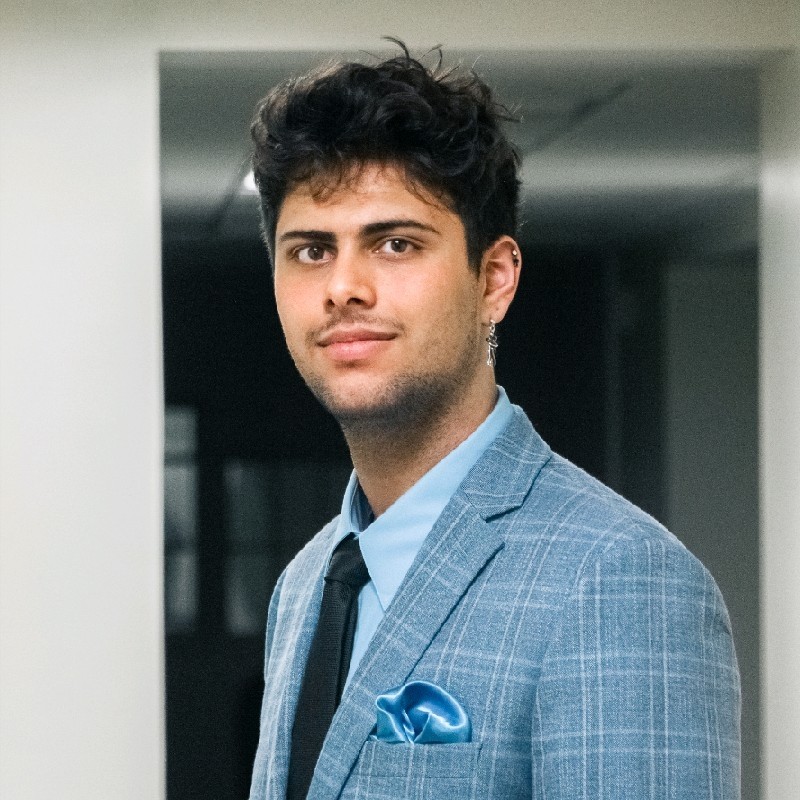
Kaden Pirmohamed
I build AI agents that find, validate, and fix real vulnerabilities. Today I do that at Pixee, where I work on the platform's agentic triage and fix systems. I came up through hands-on cyber work and ran my university's cyber defense team for three years before joining Pixee.
About
My work sits at the intersection of large language models and application security. I care most about systems that produce code changes a human can trust, not just suggestions, but pull requests that ship. The hard part isn't getting an LLM to suggest something plausible. The hard part is making the suggestion reliable enough that a real engineer would merge it without rewriting it.
I came up through hands-on infrastructure and security work. I started in IT as a high-school contractor in 2020 (BlueNovo), worked through college as a Computer Technology Support Associate at Towson, spent eight months on nuclear plant security system modernization under regulated cyber compliance frameworks (Essential Systems), and joined Pixee in January 2026 as a software engineer on the AI-Native AppSec platform.
Through college I served as President of the Towson University Cyber Defense Club from Sep 2022 to Dec 2025. I led club operations and competition teams through CCDC, all six NCL seasons from Spring 2023 to Fall 2025, MISI Hack the Building 2.0: Hospital Edition, and the major collegiate CTF circuit. I graduated from Towson in December 2025 with a B.S. in Computer Science and a track in Cybersecurity.
On the side I build open-source LLM tooling and contribute to community cyber education (Cyber Connections K-12 outreach). I hold CompTIA Security+ along with Google's cybersecurity, AI, and prompt-engineering certifications.
Now · Pixee
Pixee is an AI-Native Application Security platform. It takes vulnerabilities surfaced by existing scanners (SAST, SCA, secret scanners, dependency tools) and uses LLM-driven agents to triage them, assess exploitability, and produce reviewed, mergeable code fixes that engineering teams can ship.
As a software engineer on the platform, I contribute to the systems that make AI agents reliable enough for production code review. A significant portion of my work has been on the platform's Case-Based Reasoning (CBR) feedback loop, which captures human reviewer signal on every finding and feeds it back into how future findings are triaged and fixed. Reviewer feedback is the highest-quality data we have, and making sure the platform learns from it is what turns AI security from a demo into a tool customers actually trust.
My day-to-day spans agent behavior, multi-model evaluation, prompt and output reliability, and the supporting infrastructure. I work across the Python AI services, the Java platform APIs, and the TypeScript/React user surface, and I've contributed to roadmap-level initiatives within the analysis engine.
Tools and frameworks in regular rotation: Python, FastAPI, Pydantic AI, LangGraph, OpenAI, Anthropic, MLflow, PostgreSQL, Docker, Kubernetes, Azure, GitHub Actions.
Currently exploring
Topics I'm spending personal time on outside the day-to-day, either through reading, side projects, or club work.
Agent memory and persistent learning
How AI agents accumulate context across runs, learn from human feedback, and avoid relearning the same lesson twice. Both episodic and semantic memory patterns interest me.
Reliability in long-horizon agentic systems
Stale loops, deadline management, hallucination detection, recovery from partial failures. The unglamorous work that decides whether an agent is a product or a demo.
Multi-model architectures and routing
Choosing the right model for the right step, evaluating model swaps without regressions, and building infrastructure that doesn't lock you to a single provider.
AI-Native DevSecOps
Where LLM-driven security tooling actually lands in real engineering workflows. What earns developer trust, what gets ignored, and what changes about the SDLC when agents enter the loop.
Experience
Engineer on the AI-Native Application Security platform. Contribute across the agentic triage and fix engine, the platform APIs, and the user-facing surfaces. Focus areas include the Case-Based Reasoning (CBR) feedback loop, agent memory and reliability work, model evaluation, and the supporting infrastructure that turns research-grade agents into production tooling. Stack spans Python (FastAPI, Pydantic AI), Java, and TypeScript/React.
Three-plus years leading a collegiate cyber defense club through national-level competitions. Ran club operations, organized cybersecurity events, developed training material, conducted skill-building sessions, and established partnerships with local organizations. Directed team participation in CCDC, every NCL season (Spring 2023 through Fall 2025), MISI Hack the Building 2.0: Hospital Edition, and the major collegiate CTF circuit (UTCTF, UMDCTF, DawgCTF, Bucket CTF). Conducted vulnerability assessments and reporting during exercises; used industrial cyber tooling (Cyber Vision, Elastic Search, Nozomi Networks) for network analysis.
Worked on nuclear plant security system modernization under NEI 08-09, NERC CIP, and the NIST Cybersecurity Framework. Coordinated phased replacement of servers, cameras, and door controllers while maintaining Critical Digital Asset protection. Designed fault-tolerant primary/backup architectures meeting 99.9% availability requirements. Deployed fiber-optic networks supporting 200+ card readers, 1,000+ alarm points, and 65,000 credentials. Contributed to alarm and access-control security software, implemented a Video Management System with real-time alarm processing, and established user access controls and audit logging meeting regulated compliance requirements.
Summer research project in the Computer Science department under a faculty advisor. Built and deployed a Retrieval-Augmented Generation pipeline for educators, used by students in a cybersecurity Case Studies course to interact with course materials through intelligent question answering. Self-contained stack so it could be deployed on commodity hardware: Docker Compose, Ollama, OpenWebUI, FAISS, Python.
University IT operations role through my last two years of undergrad. Securely destroyed 500+ hard drives and SSDs via degaussing and SSD chain-of-custody disposal under documented university security protocols. Imaged and deployed 700+ computers across academic and administrative departments on both Mac and Windows. Maintained inventory systems of record, handled technology trade-ups and refresh cycles, and resolved support tickets spanning hardware, OS, identity, and networking.
Volunteer cybersecurity educator for 6th-12th grade students. Designed and delivered cybersecurity curriculum, created hands-on activities and lesson plans introducing offensive and defensive security fundamentals to early-career learners. Contributed to Towson University's STEM excellence initiatives and worked to foster early student interest in cybersecurity through interactive teaching.
First professional tech role, started during high school. Three years of consistent contract work before starting university. Supervised service tickets and performed remote troubleshooting in ConnectWise; managed device imaging and asset logging through Asset Guard; configured server infrastructure and handled Microsoft Azure user management; executed hardware repairs and maintenance; developed IT process documentation.
Selected Projects
A few open-source things I've built outside of work, mostly at the intersection of LLMs and security.
A complete Retrieval-Augmented Generation system for university course material. Summer research project. Docker, Ollama, OpenWebUI, FAISS, custom retrieval pipeline.
github.com/Lightmean03/askzathras →A social-deduction game where 10+ LLM agents play Mafia. Pydantic AI backend, React frontend, configurable across OpenAI, Anthropic, Google, Ollama, and Grok.
github.com/Lightmean03/AI-Mafia →Tech & Skills
What I reach for, organized by what I actually use rather than what I have a passing familiarity with.
AI · LLM · Agent Engineering
Application & Cyber Security
Languages
Web & Backend
Infrastructure & Tooling
Practices & Methodology
Recognition & Competition
Cyber competitions I've competed in or led teams through.
Education
Bachelor of Science in Computer Science with a concentration in Cybersecurity. Graduated Fall 2025. Served as President of the Towson Cyber Defense Club throughout undergrad (Sep 2022 - Dec 2025). Competed in all six NCL seasons over my time at Towson and led teams in CCDC, MISI Hack the Building, and the major collegiate CTF circuit. Completed a summer undergraduate research project building an LLM RAG system for use by students in a cybersecurity Case Studies course.
Certifications
Let's connect
I'm open to chatting about agent engineering, autonomous code remediation, memory-augmented AI, AI-Native DevSecOps, or anything at the boundary of large language models and secure code.